Wednesday, January 29, 2014

Fascial Release Series: The Total Body Lesion

If you have ever been a client at EPT, you know we treat the person as a whole.  Although you may come in with elbow pain, we may spend time focusing on how you are habitually standing or how you swing your arms when you walk.  We know how these everyday repetitive motions can cause stress on the body.   This class touched on and expanded upon these concepts.
One major principle in the osteopathic philosophy is that the body is a dynamic unit of function.  When we are speaking of the body, we are not just talking about the physical dimension, but the whole person: mind, body, and spirit. 


In the class, we spoke many times of the Total Body Lesion, which is defined as the sum of dysfunctions of mind, body, and spirit at any given moment in time.  This means that what is making your body hurt is not only the latest ache or pain, but an accumulation of things over time.  That series of ankle sprains during high school soccer, the C-section or hernia repair, those two fender benders, and the stress of starting a new job all have contributed to what you are feeling today.  The pain of these smaller injuries usually quickly fades without need for treatment; at the most, maybe with the aid of a little Advil, ice, and rest.  Although the muscles and ligaments have healed, we are blissfully unaware of the residual muscle, joint, and fascial tension that remains.


When you come to PT, you might identify the “final straw” as that bout of shoveling in sub-zero temps (thanks Vermont!), but your body has endured all of the previous traumas and these things must be considered.  When we evaluate you, we won’t just look at your back, but at your entire body.  After evaluating, we then can perform Total Body Balancing, which may mean we are working up at your shoulder, even though you came in with back pain.

On the next post, we look forward to sharing about one component of Total Body Balancing - fascial release!  

Monday, January 27, 2014

Expanding our knowledge: Fascial Release of the Upper Quadrant

We are very lucky as physical therapists at Essex PT that we are encouraged to continually develop and enhance our skills.  Although our education is very comprehensive, there are always new techniques or methods that can improve our clients’ experiences and outcomes.  Our clinic hosted a class recently focused on facial release, taught by Kerry D’Ambrogio.   Over the next week, we will have a short series of blog entries focused on some of the highlights/interesting points of the course.  These will focus on:

·         What is a Total Body Lesion?
·         What is fascia/fascial release?
·         High Five! - Our staff's top 5 ideas/tips taken from this class that will benefit our clients today!

Monday, January 20, 2014

Postural Tip of the Week - Stop Leaning!

Our postural tip of the week this week has to do with the way we lean our upper bodies when we are sitting.
Whether you see a driver with his left hand on the steering wheel leaning to rest his arm on the center console...


...Or a "desk jockey" leaning to use his mouse...


Both are doing the same thing...leaning to the right.

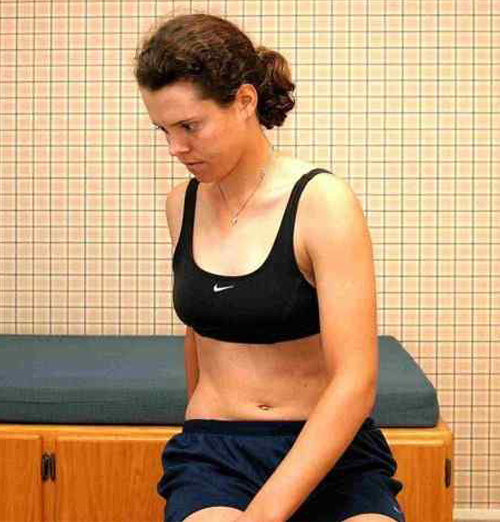
Our tip this week is to be mindful of keeping your left ribs down when you are sitting so that the shoulders remain level.  We often notice patients lean to the right, causing the right shoulder to drop.  This problem is not from the shoulders, but from the ribcage due to a lack of recruitment of your left abdominals.  Turn them on to fix this postural problem!

Monday, January 13, 2014

Postural Tip of the Week - Can you feel your arch?

It's Monday - time for the postural tip of the week!

Whether you are standing, sitting, or walking, you should be able to feel the arch of your right foot supported by the ground/your shoe.  If you find yourself often rolling to the outside of that foot, attempt to bring your weight back through the arch.  When you are making this correction, make sure your knee doesn't fall in; by keeping it aligned correctly, you will be using your right glute muscle as well!

Monday, January 6, 2014

Postural Tip of the Week - Rotate!

Here's another postural tip of the week!

Try to keep your left hand on your right knee as you rotate your trunk to the right.  Feel your right shoulder blade pull back slightly.  Breathe in this position.

Thursday, November 14, 2013

Postural Tip of the Week: Knee position when sitting


We want to start updating the blog with regular postural tips; things you can change in your daily posture that can help you achieve and maintain "neutral".  These are not usually big changes - they are little things to try that can make a big difference in keeping those muscles that typically go unused in many people.

Today's tip is in the sitting position.  When sitting, attempt to pull the left knee back behind the right.  When looking down, you should see something that looks like the knee position below:


The key muscle to feel is the left inner thigh.  See if you can keep that on for your entire ride to work, or during your favorite TV show...it's hard work!

Tuesday, October 22, 2013

Pain in Dancers: When to Act?


Dancing is a sport as much as it is artistic expression.  In my experience, dancers frequently assume they will be injured some time during their dance careers and therefore don't always pay close attention to pain that they feel when they dance.  Remember that pain is your body's way of saying that something is not right.  Just like the sensation of hunger tells you your body needs food; or your heavy eyelids and yawning tell you that your body needs sleep, pain is your body's way of communicating that a body part may be getting too much strain.  Follow these guidelines to know when you should seek help.

  • Your pain last longer than two weeks
  • Your pain is greater than a 5/10 for less than two weeks
  • Pain that you cannot make better with self care (rest, ice, compression, elevation)
  • If you have a sense of instability with pain or without (i.e. your ankle keeps giving way and rolling)
  • Pain that appears to be getting worse or more frequent (i.e. you used to only feel it when you dance, but now you are starting to feel it even walking around at home)
  • Pain that prevents you from dancing or doing certain movements in dance
Remember that pain is a warning sign that your body may need attention.  You will be a stronger, happier, healthier dancer if you get your pain attended to quickly!  

Katy Gamelin, PT